
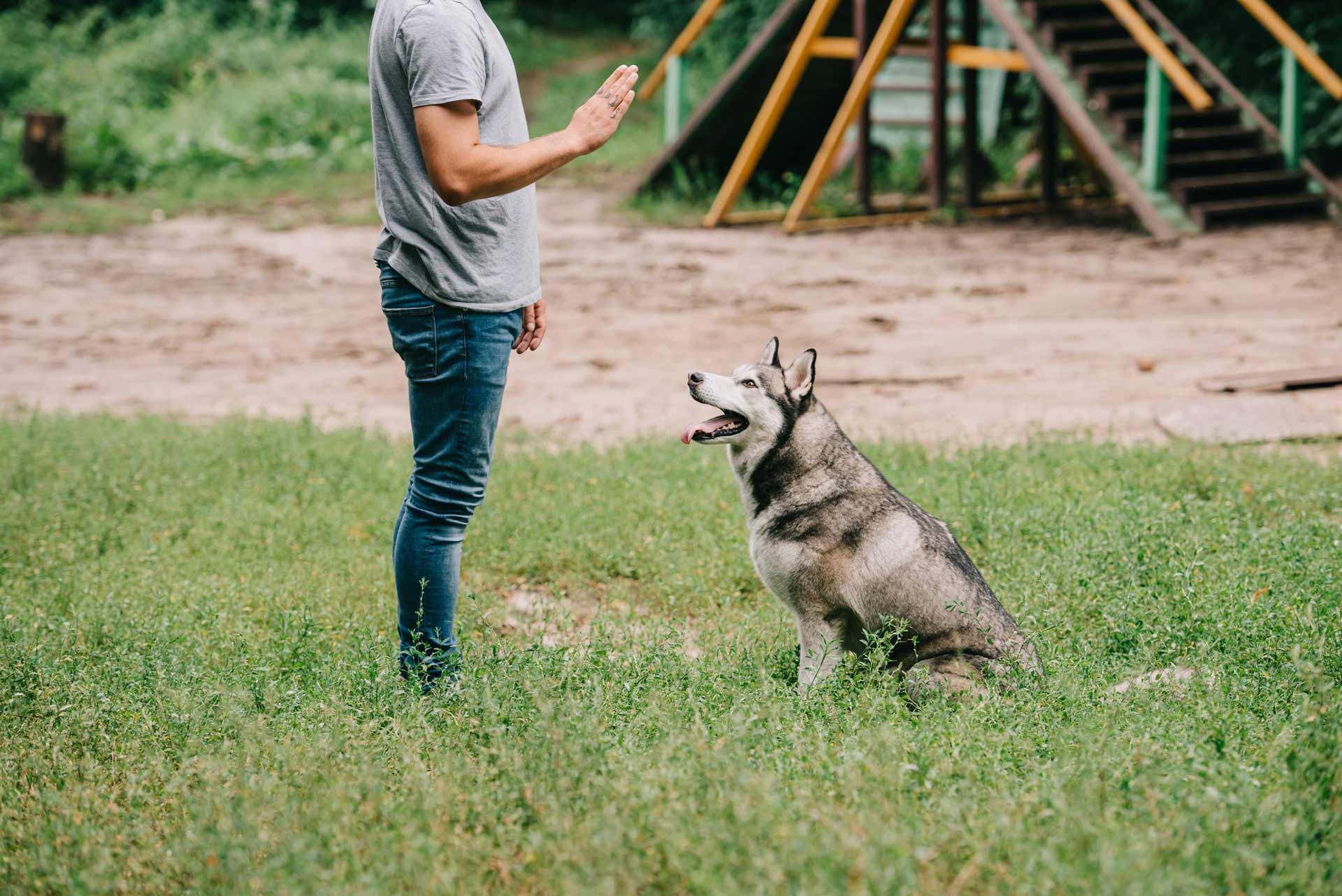
Advance Obedience
Yes Marker & No Marker:
Dogs are trained to clearly distinguish between correct and incorrect behaviors. The Yes Marker signals that
the dog performed the command correctly and a reward is coming, while the No Marker gently indicates that
the behavior was incorrect, helping the dog learn and improve.
Long-Distance Recall:
Dogs learn to come to the master from a long distance and sit automatically in front without a command. If
the master gives the heel command, the dog moves to the left side of the master and sits in the basic heel
position. Dogs remain focused even with distractions and will reliably follow the master’s instructions.
Distance Control Exercise:
Dogs are trained to respond to basic commands—sit, down, stand—over long distances. Commands can be
given in any order, and the dog will perform them precisely, even if the master chooses a command
differently from what might be expected. This strengthens obedience, focus, and responsiveness from afar.
Send-Away Drop Exercise (Long Distance):
Dogs are trained to go from the master to a target area over a long distance and automatically lie down in a
calm and controlled manner. They remain in that position without moving until the master gives the return
command. This ensures the dog is steady, focused, and disciplined even at a distance.
Stay Command:
Four types of stay are taught with very strong proofing:
Noise proofing: The dog ignores loud or sudden noises.
Master out of sight: The dog holds position even when the master is not visible.
Different terrains: The dog maintains position on grass, sand, or uneven ground.
Touch and interaction: Even if the dog is touched or other dogs sniff or approach, it stays calm, silent, and
does not break position.
Durations: Down Stay – 15 minutes, Sit Stay – 5 minutes, Stand Stay – 2 minutes.
Motion Stay: The dog freezes instantly even while moving, running, or approaching the master.
Off-Leash Walk:
Dogs are trained for sharp and clean turns—left turn, right turn, left about-turn, right about-turn—and
practice walking at different speeds: slow, normal, and speed walk. Reverse walk is also included to teach the
dog to move backward smoothly on command. There is no forging, lagging, or distraction, and the dog
remains perfectly positioned beside the master.
Fancy Commands:
Dogs learn fun and advanced tricks:
Shake hands with both front paws
Spin left and right
Speak (bark on command)
Pretty sit (if the dog has strong back legs)
These commands motivate and refresh the dog while improving coordination, confidence, and engagement.
Impulse Control (Direct & Indirect Reward):
Dogs develop strong impulse control by shifting from direct reward (immediate food or toy after command)
to indirect reward. In indirect reward exercises, food or a toy is placed in front of the dog, but the dog must
perform multiple commands given by the master—sit, down, spin, shake, place, or others—before being
allowed to access the reward. Commands are given in any order the master chooses, challenging the dog to
stay attentive, patient, and obedient. Dogs with high prey drive can perform these exercises with toys as
rewards as well. For dogs with high prey drive, we also teach the Out Command. This reinforces extreme
patience, self-control, and focus.
Muzzle Command:
This command trains your dog to calmly and safely wear a muzzle on cue. It is important for situations such
as vet visits, grooming, or public outings, helping prevent accidental biting and making handling stress-free
for both the dog and the owner. Teaching the muzzle command ensures your dog stays comfortable and
relaxed while wearing it, promoting safety and confidence.
Hold Command:
In this exercise, dogs are trained to pick up and hold any article that they can carry in their mouth—such as a
PVC pipe, wooden piece, small bag, toy, or any similar item—steadily until given further instruction.
Simultaneously, the Out Command is taught, so the dog releases the article only when the master gives the
cue. This exercise builds patience, control, and reliable obedience while handling objects.
Retrieving Command:
In this exercise, the master throws an article—such as a ball or a dumbbell (wooden or plastic)—and the dog
is trained to go, pick it up, and return to the master. Upon returning, the dog sits in front of the master and
waits patiently for the Out Command. When the master gives the command, the dog releases the article. This
exercise strengthens focus, obedience, and controlled retrieving skills.
Duration
Happy dog with high food and prey drive: 4 months
Reactive, dominant, or stubborn dog: 5 months
DISCLAIMER:
In the Advanced Obedience Package, most dogs are transitioned from direct reward—where they receive
immediate food or toy rewards—to indirect reward methods. In this approach, the dog performs multiple
commands or exercises before accessing the reward, which can be food or prey (ball, toy or tug ropes). This
teaches patience, focus, and strong impulse control, encouraging the dog to work for the reward rather than
expecting it instantly. Some dogs may find it challenging to shift from direct to indirect reward due to breed,
age, drive, or character, and for these dogs, training may continue on direct reward while still achieving
effective learning and obedience. Only dogs with good prey drive can be effectively channeled from food
drive to prey drive, and prey drive largely depends on the dog’s genetic.
Registration
Don’t wait to start your puppy’s training! Register now and give your furry friend the best start in life.
Need Help?
Our team is here to guide you every step of the way. If you have any questions about the program or need additional information, don’t hesitate to reach out!
- +91 87782 51225
- info@anbuk9school.com
- Everyday 08:00 AM - 18:00 PM
